
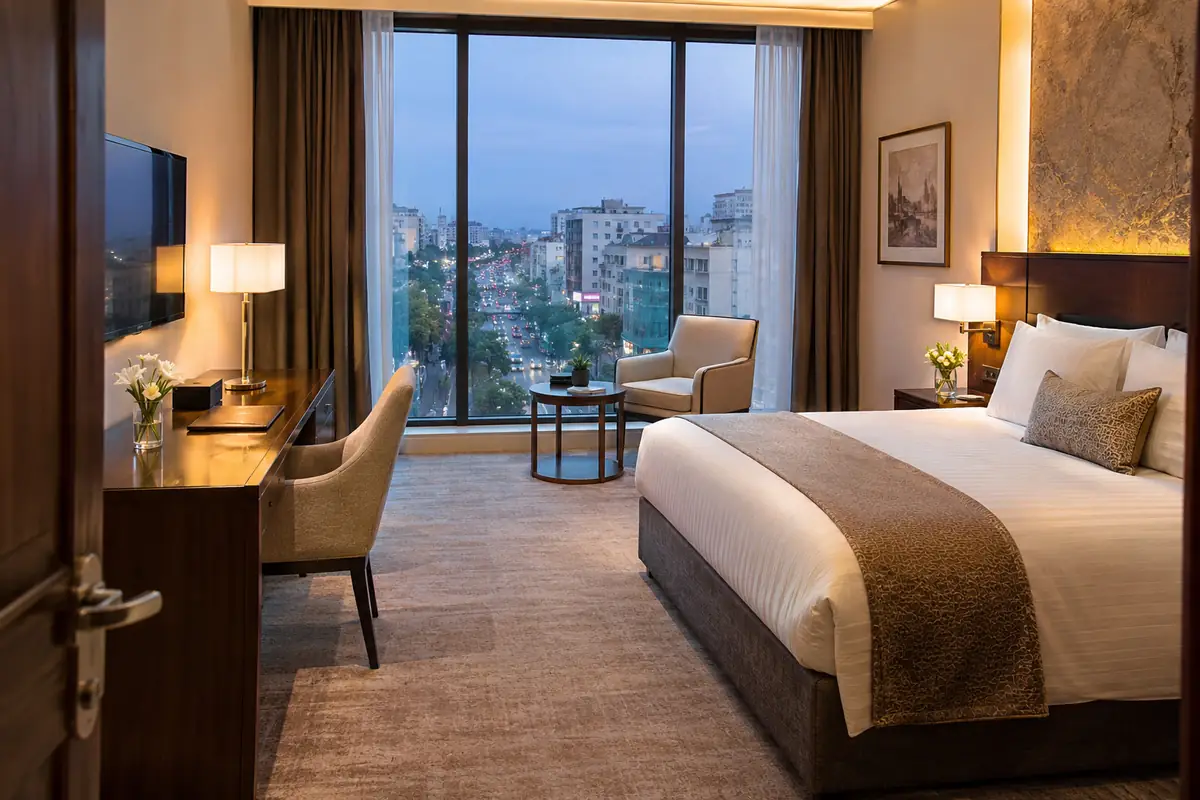
Setif is a provincial capital on Algeria's high plateaus, more than a thousand metres above sea level, and its hotels, booking options and accommodation serve both tourism and business. Sitting between Algiers and Constantine, the city is a commercial and industrial crossroads, so most guests are sales representatives, company managers, students and families visiting the region. The hotels are mostly recent three- and four-star properties in the centre and around the large shopping complex. Demand follows the working week and school holidays far more than any tourist season.
Hotel comparison for Algeria
Pick a city and a star rating, then run the search.
| Hotel | City | Stars | Area | Observed price (US$) |
|---|---|---|---|---|
| Novotel Sétif | Setif | ★★★★ | Sétif – Sétif | — |
| Park Mall Hotel & Conference Center | Setif | ★★★★ | Sétif – Park Mall | — |
| Plus Hotel Sétif | Setif | ★★★★ | Sétif – Sétif | — |
| Rénéa Hotel | Setif | ★★★★ | Sétif – Sétif | — |
| Noxi Hotel | Setif | ★★★ | Sétif – Sétif | — |
| ibis Sétif | Setif | ★★★ | Sétif – Centre | ≈ 7 |
| Hôtel El Hidhab | Setif | — | Sétif – Sétif | — |
7 hotel(s) found
Setif hotels, booking and accommodation: what to expect
Setif is not a classic holiday resort. It is a large inland city where accommodation is built mainly around professional travel. Visitors find recent three- and four-star hotels, several international chain properties and a few older local addresses.
Establishments listed for the city include the Park Mall Hotel & Conference Center, the Renea Hotel, the Noxi Hotel, an ibis, a Novotel and the Plus Hotel, along with the older El Hidhab hotel. The official classification of each one is worth checking when you book.
Rooms range from simple transit rooms to comfortable ones with a desk, which suits business travellers. Meeting and conference rooms are common in the newest hotels.
Groups, seminars and conferences should book early. The city hosts many professional events, and the larger hotels fill quickly.
Check what the room price includes, such as breakfast, parking and airport pick-up, since practices differ from one hotel to another.
A high-plateau city on the Algiers–Constantine corridor
Setif lies in north-eastern Algeria, on the high plateaus at around 1,100 metres. The town had close to 290,000 residents at the last published census, and the province covers more than 6,500 square kilometres. It is east of Algiers and roughly 130 kilometres west of Constantine.
That position makes it a natural crossroads: roads, a railway line and an airport connect it to the country's main centres. It is often described as the commercial capital of the east, with industry in plastics, food processing and building materials.
There are two university campuses, which keeps the streets lively and brings visitors for exams and studies. For travellers it means a wider choice of restaurants, cafés and shops than in most cities of similar size.
Market days and trade events fill the city with visitors from neighbouring provinces, which is worth remembering when choosing dates.
Getting there by air, rail and road
Setif's international airport is about ten kilometres from the centre and handles flights to Algiers and a few routes to France. A taxi or hotel transfer to the city takes roughly twenty minutes, depending on traffic.
The railway station is on the Algiers–Constantine line. A handful of passenger trains run each day, several of them to Algiers, which suits those who would rather avoid the road in winter. A tram also runs in the city.
By road, the east–west motorway and national roads lead to Algiers, Bordj Bou Arreridj and Constantine. Intercity taxis cover regional trips.
If you arrive late, tell the hotel. Most reception desks stay open day and night, but confirming your arrival time avoids a reassigned room.
Districts and areas worth considering
The city centre, around Independence Square and the Ain El Fouara fountain, is the handiest base: cafés, pastry shops, banks and administrative offices are all within walking distance. It is the best choice for a first visit or a short stopover.
The area around the Park Mall complex, described as one of the largest shopping centres in the country, suits modern, family-oriented stays. A hotel is attached to the complex, with restaurants and shops close by.
The surroundings of the railway station and the main roads appeal to people in transit who value quick access over atmosphere. Hotels on the outskirts are quieter and often easier to park at.
Before booking, look at the exact location on a map. The city is spread out, and traffic can be heavy at rush hour.
Tourism and business in Setif: two kinds of guest
Business guests dominate: manufacturers, buyers, hauliers, visiting managers, and people attending trade events or training. They look for dependable internet, a meeting room, an early breakfast and a clear invoice.
Tourism does exist, mostly built on history and nature. The city has a rich Roman and Byzantine past and a national museum known for its mosaics, while the province holds ancient sites, dams, thermal springs and mountain scenery.
Weekends and school holidays bring families from across the east, drawn by the shopping complex, the amusement park with its zoo and walks in town.
This mix explains why weekdays are busier for business hotels and weekends for family-oriented ones. Booking outside those peaks leaves more choice of rooms.
Many guests combine both purposes, adding a day of sightseeing to a work trip.
Climate and seasons: when to stay
Setif has a semi-arid, continental-influenced climate. Summers are hot and dry, with peaks that sometimes exceed forty degrees in July and August, though the altitude keeps evenings cooler than on the coast.
Winters are cold and wet, and snow falls regularly, up to about forty centimetres a year. Heavy snow can slow traffic on mountain roads and delay a departure.
Spring and autumn are the most pleasant seasons to visit the city and the surrounding sites, with mild temperatures and long days. April and November are, however, among the wettest months.
In winter, check that heating works well in the room. In summer, air conditioning is a useful criterion. Both points are easy to settle by phone before arrival.
What to see near your hotel
The Ain El Fouara fountain, a landmark of Independence Square, is the best-known sight in town. The national museum holds Roman mosaics, including a famous depiction of Venus. The Byzantine citadel and the old mosque round out a half-day walk.
The Emir Abdelkader garden and the amusement park with a zoo offer easy outings for children. History lovers can head to the Roman site of Djemila, a UNESCO-listed place within the province.
The province also has thermal springs, such as Hammam Guergour and Hammam Soukhna, and dams such as Ain Zada and El Mouane, popular for weekend trips.
For an excursion, ask the reception for advice. Public transport serves some sites poorly, and a taxi for the day is often simpler.
Sétif hotel stays: a calm approach to reservations, payment and the trip itself
Contacting the hotel directly is still the clearest way to book. Get the room category, the length of stay, breakfast and your expected arrival hour in a written message, and save it on your phone.
Payment is often made on site, in cash in dinars or by local bank card. Cards issued abroad often fail at the desk, so find out beforehand how the hotel wants to be paid.
Bring your passport or identity card, since hotels register every guest on arrival.
The city is lively and generally safe. Usual precautions are enough: keep documents on you, avoid showing large sums of cash and use clearly marked taxis. In winter, pack warm clothes, because nights are cold.
Frequently asked questions
Who stays in Setif hotels?
Setif hotels welcome mainly business travellers, sales representatives and seminar participants, followed by families and students. Weekdays are therefore the busiest period, while weekends bring visitors from the surrounding region.
How do I get from Setif airport to my hotel?
The airport lies about ten kilometres from the centre. A taxi or a transfer arranged by the hotel is the simplest option, taking around twenty minutes. Confirm your arrival time with the hotel before you travel.
Does it get cold in Setif?
Yes, in winter. The city stands above one thousand metres, and snow is frequent, sometimes up to forty centimetres a year. Pack warm clothes and check that the room heating works before you book.
Further reading
- Setif, city overview : Overview of the city's location, climate, transport links, landmarks and economy.