
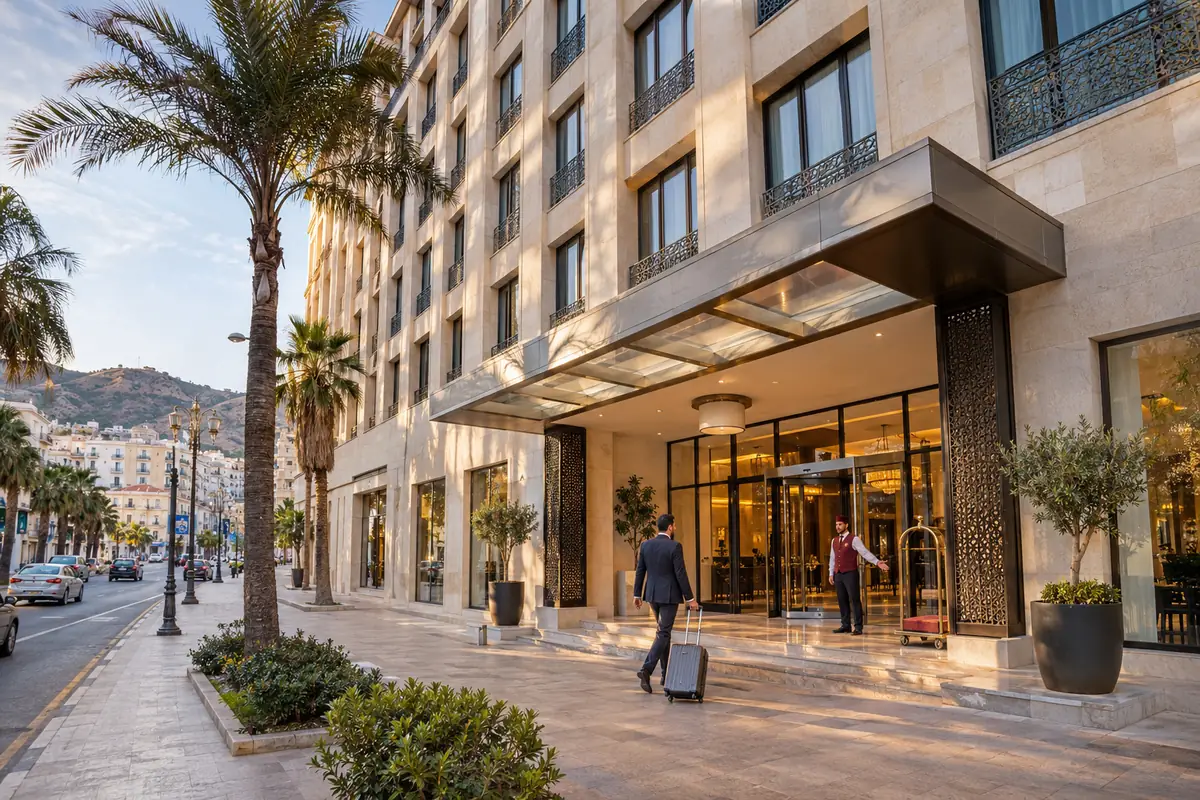
Oran, the big port city of north-western Algeria, offers hotels for every kind of trip, straightforward booking through international chains, comfortable rooms and accommodation facing the Mediterranean. The capital of its wilaya, backed by the Murdjadjo massif, receives business travellers, congress delegates, families visiting relatives and music fans drawn to the birthplace of raï, a genre that grew from the city's streets and weddings. Properties are spread between the historic Plateau district, the Corniche, the cliff road, Canastel and the area around Es Sénia airport.
Hotel comparison for Algeria
Pick a city and a star rating, then run the search.
| Hotel | City | Stars | Area | Observed price (US$) |
|---|---|---|---|---|
| Le Méridien Oran Hotel & Convention Centre | Oran | ★★★★★ | Oran – Akid Lotfi | ≈ 25 |
| Oran Bay by Accor | Oran | ★★★★★ | Oran – Route des Falaises | — |
| Royal Hôtel Oran – MGallery | Oran | ★★★★★ | Oran – Centre-ville | — |
| Best Western Hôtel Colombe | Oran | ★★★★ | Oran – Oran | — |
| Eden Phoenix | Oran | ★★★★ | Oran – Es Sénia | — |
| Four Points by Sheraton Oran | Oran | ★★★★ | Oran – Canastel | ≈ 24 |
| Liberté Hôtel Oran | Oran | ★★★★ | Oran – Oran | — |
| ibis Oran Les Falaises | Oran | ★★★ | Oran – Route des Falaises | ≈ 51 |
8 hotel(s) found
Oran, the big city of north-western Algeria
Oran is the capital of the wilaya of the same name, in the north-west of the country, roughly four hundred and thirty kilometres west of Algiers. Built around the Gulf of Oran, it climbs the slopes of Mount Murdjadjo above the sea and counts as the second city of Algeria in economic and demographic weight.
That position explains the mix of visitors: executives travelling for the port, industrial zones or trade fairs, holidaymakers drawn by the coast, families visiting relatives, students and conference participants. The city stays lively late into the evening, especially in summer, and its shopping streets remain busy after dark. Cafés, fish restaurants and ice-cream parlours along the seafront make up the usual backdrop of a stay, whether short or long.
Oran hotels: booking rooms for your kind of trip
The choice in Oran covers several profiles. At the top end, the Royal Hotel Oran, part of the MGallery collection, is a five-star property in the Plateau district with restaurants, a bar, a hammam, a sauna and a fitness centre. Le Méridien Oran Hotel & Convention Centre, in the Akid Lotfi area, combines rooms, a swimming pool and a congress centre with coastal views.
For a tighter budget, Accor runs an ibis on the cliff road, while Four Points by Sheraton stands on the heights of Canastel. Urban hotels such as Best Western Hôtel Colombe or Liberté Hôtel suit business trips, and the Eden Phoenix is close to Es Sénia airport. When you book, compare cancellation terms, whether breakfast is included and the distance to the district you want, rather than relying on the star count alone.
Getting to Oran: airport, tram, road and rail
Ahmed Ben Bella Airport, at Es Sénia, lies about twelve kilometres from the centre and links Oran with Algiers, several Algerian cities and destinations in France and elsewhere in Europe. It does not operate around the clock, so tell your hotel your arrival time; some properties offer an airport shuttle, as the Royal Hotel does according to its schedule.
In town, the tram serves some thirty stops between the centre, Es Sénia and the east of the agglomeration, and avoids rush-hour traffic. Taxis and chauffeur-driven cars complete the picture. From Algiers, road and rail both reach Oran in several hours, and neighbouring towns such as Mostaganem, Sidi Bel Abbès or Tlemcen are roughly one to two hours away by road.
Seafront accommodation: Corniche, cliffs and Canastel
The choice of district matters as much as the choice of hotel. The cliff road and the Corniche run along the coast, with seaside hotels such as Oran Bay by Accor or the ibis Les Falaises offering open views and easy access to waterfront restaurants. In the evening the promenade is busy, which can mean some noise on the street side.
Canastel, on the eastern heights, gives a more open setting and views over the gulf, but involves more car journeys. The Plateau and the city centre suit those who prefer to walk between squares, shops and offices. Es Sénia is mainly useful for quick stopovers or early departures, thanks to the nearby airport and tram line.
Seeing Oran: the old medina, squares and forts
Central Oran is best explored on foot. The Place du 1er Novembre, framed by Art Deco façades, forms the heart of the city, not far from the Royal Hotel. Lower down, Sidi El Houari, the old medina on the slopes of the Murdjadjo, holds the Bey's palace, the Pasha Hassan mosque and lanes under restoration.
Higher up, the Spanish-built fort of Santa Cruz overlooks the bay and the chapel of Notre-Dame de Santa Cruz; the climb gives one of the best viewpoints over the city and the sea. Oran is also the birthplace of raï, a musical genre that began among shepherds before artists of international fame carried it abroad. Allow a day for the medina and squares, half a day for the fort, and bring sturdy shoes for the slopes.
Beaches and day trips around Oran
Swimmers fan out from the city. Aïn El Turk, about fifteen kilometres to the north-west, has hotels and entertainment in season. Further west, Les Andalouses and Bousfer are well-known beaches, very busy in summer, as is Mers el-Kébir, a natural harbour beneath the Murdjadjo.
Urban growth weighs on water quality in some places: ask locally which beaches are supervised and avoid stretches close to ports and outfalls. For a day trip, shared taxis and hired cars reach these beaches, but in July and August it is better to leave early to avoid coastal traffic jams. Seaside hotels make these outings easier to organise.
Away from the sand, the coast also offers short boat trips and coastal walks in season. Families usually choose a hotel with parking, since public transport to the outer beaches is limited late in the day.
Climate and seasons for a stay in Oran
The climate is Mediterranean and semi-arid: hot, dry summers and mild winters, with rain mostly from November to May. In August, daytime highs are around thirty-two degrees, while January highs hover near seventeen. Rainfall stays modest, but sudden downpours can occur in autumn.
Spring and early autumn suit the medina, the fort and the viewpoints best, without excessive heat. Summer draws families to the coast; rooms are in strong demand then, especially during school holidays and public festivals, so booking ahead is wise. Winter is quieter and suits business stays and cultural visits in a less crowded city.
Sea breezes soften the heat on the coast, while inland districts feel warmer. Bring a light jacket for winter evenings, which can be windy and damp, and sun protection from late spring.
Oran accommodation on the Mediterranean: practical advice
Before leaving, check the hotel's payment terms: many properties accept cards, but some prefer cash in dinars. Carry identity documents, which are requested at check-in, and keep your booking confirmation on paper or on your phone. For late arrivals, state the expected time in advance.
For business, favour a hotel with meeting rooms and a reliable connection; for a family break, look for a spacious room, air conditioning and parking. The area around the large hotels is generally lively and safe, with the usual precautions: valuables put away, licensed taxis and late outings in a group. Seafront accommodation for summer is best chosen early.
Staff at the larger hotels generally speak Arabic and French, and often English as well, which helps when asking about transfers, laundry, late breakfast or a quiet room away from the street.
Eating out and evenings in Oran
Oran is known for its seafood, and the harbour districts and the seafront have fish restaurants where the day's catch is grilled or served in a stew. Traditional dishes such as couscous, chorba and the local street snack called karantika, a chickpea flan, appear on many menus and in small cafés.
In the evening, families and young people stroll along the Corniche and the squares of the centre, and cafés stay open late, especially in summer and during festivals. Hotels with their own restaurant are practical after a long day of meetings or visits, while those in the centre put dozens of other options within walking distance. Ask the reception for a well-regarded address instead of choosing a place at random.
Frequently asked questions
Where should I stay in Oran on a business trip?
The centre, the Plateau and the Akid Lotfi area hold the upscale hotels with meeting rooms and restaurants. Le Méridien has a convention centre, and the Royal Hotel offers meeting spaces.
How do I get from Oran airport to the city centre?
Ahmed Ben Bella Airport is about twelve kilometres from the centre. A taxi is the most direct way, and some hotels offer a shuttle on request. Tell your hotel your arrival time.
When is the best time to visit Oran?
Spring and early autumn bring pleasant temperatures for the medina and the fort. Summer suits the beach, but seafront rooms should be booked early.
Further reading
- Royal Hotel Oran - MGallery Collection : Official English page of the Royal Hotel Oran, with services, dining, spa and location in the Plateau district.