
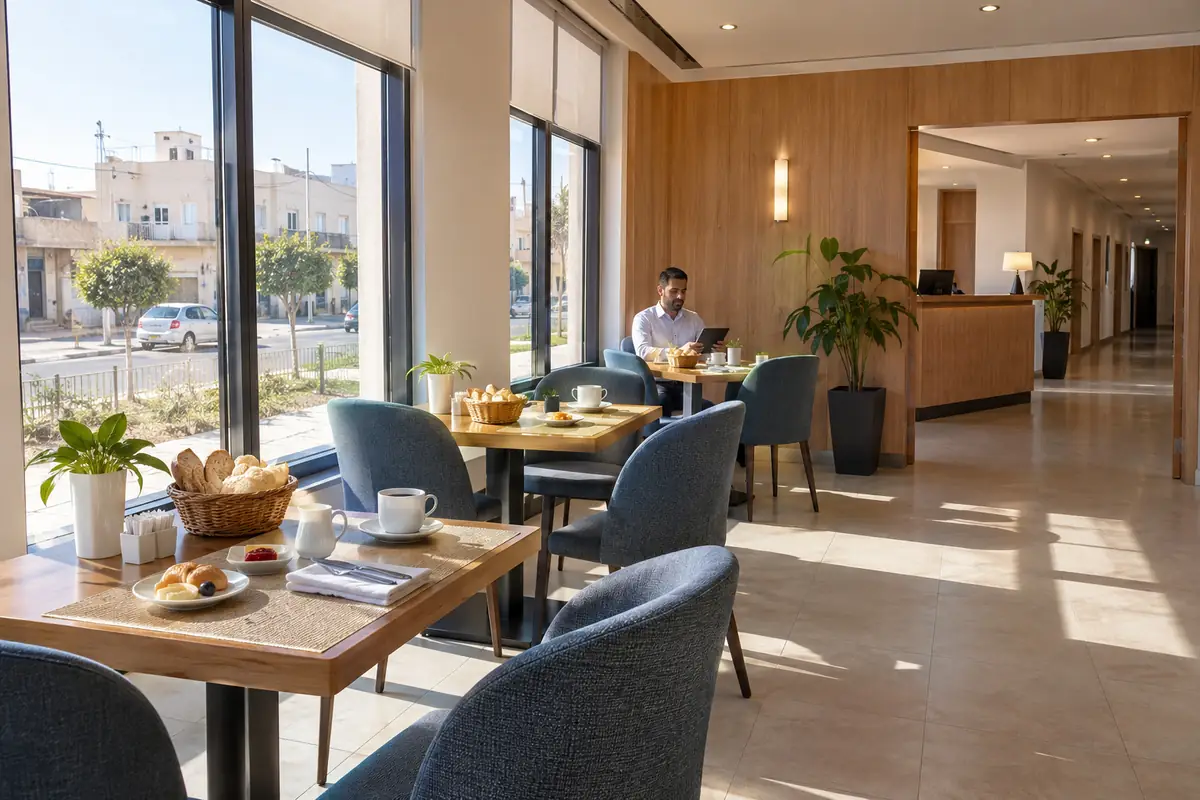
Ain Oussara is a large town on the Sersou plain, about 88 kilometres north of Djelfa, with a few hotels, simple booking by phone, rooms of modest standard and accommodation geared to overnight stops on the road south. Crossed by the RN1, this farming and industrial town of more than a hundred thousand residents hosts drivers, sales staff, families and technicians travelling to the southern provinces or heading back towards Medea and Algiers. Lodging clusters around the main roads and remains limited, so it is wise to check every address before arriving.
Hotel comparison for Algeria
Pick a city and a star rating, then run the search.
No hotel listed for this city yet.
Ain Oussara, a plateau town on the road south
Ain Oussara lies about 200 kilometres south of Algiers, on the northern edge of the high plains, at an average altitude close to 700 metres. The terrain is generally flat, which explains the town's farming vocation: cereals from the Sersou plain and sheep rearing. Its name refers to a nearby spring, and the place grew around a military post and a weekly market.
Today the municipality has more than a hundred thousand inhabitants and ranks among the largest settlements of the Djelfa area. Its administrative status has changed: it is among the districts raised to the rank of province in the recent territorial reorganisation, which is why it may also be searched under its former affiliation.
An industrial zone at the southern exit includes a flour mill, a glassworks, a dairy, a soft-drink factory, a pipe factory and a large clothing workshop. These activities bring representatives, hauliers and site managers every week who need a room for one or two nights.
Getting to Ain Oussara: RN1, bypass and nearby towns
The town is a crossroads. The RN1, the trans-Saharan axis linking Algiers with Tamanrasset, runs through it, and a bypass has been built to the west to divert part of the through traffic. The RN40B completes the junction. These roads place the town about 130 kilometres south of Medea, 120 kilometres west of Bou Saada and 155 kilometres east of Tiaret.
From Algiers the trip is made by road in a few hours depending on traffic, whether by car, intercity coach or shared taxi towards Djelfa. For those arriving from the south, Djelfa is roughly 88 kilometres away, which lets you decide where to sleep depending on the hour.
The Ain Oussara airfield is an air force base and is not meant for ordinary passengers. No commercial flight specific to the town could be confirmed, so check with the airlines for civil airports in the region before booking. Away from the main roads signage can be sparse, so a route saved on your phone is useful.
Ain Oussara hotels: a limited accommodation offer
Despite its size, Ain Oussara is not a town of large hotels. The booking platforms consulted show few properties registered under its name; most hotels listed for the region are in Djelfa, some of them on the RN1. Expect a restricted supply made up of small hotels, guest houses and transit lodgings.
The travellers who sleep here are mostly professionals passing through, and establishments adapt to that rhythm: late arrivals, early departures and a need for safe parking for a vehicle or truck. Comfort is uneven, and stars are not always displayed. Ask for a photo of the room and whether hot water, heating and Wi-Fi are available.
If you would like more choice, compare with Djelfa before deciding, then consider sleeping there and driving to Ain Oussara for the day. For a single night on the RN1, a hotel near the main road is often enough. Do not count on availability during religious holidays or large family gatherings.
Booking rooms in Ain Oussara: how it works
Booking is generally done by phone or message, sometimes through a platform when the property is listed there. In every case state the arrival date, the number of nights, the number of guests and your approximate time at reception.
A few practical precautions:
- get a written confirmation with the hotel name and the exact address;
- ask in advance which payment method is accepted, since cash is still common;
- say whether you travel with a commercial vehicle that needs safe parking;
- keep an identity document within reach for check-in.
If you cancel, tell the property as early as possible: in a small establishment, a room released in time helps another traveller. If you arrive late at night, mention it so that the reception stays open and the room is not given to someone else.
Continental climate: choosing the right season
The climate is continental and dry, of the cold semi-arid type. Winters are cold and fairly humid, with morning lows around 1 °C in January, while summers are hot and dry, with highs near 37 °C in July and August. About 240 millimetres of rain fall each year, mostly in spring and autumn, September being the wettest month.
Spring is very short, and sandstorms may occur during dry spells. The most comfortable seasons for travel are therefore late spring and early autumn, when days are mild and nights cool.
In winter, check that your room has reliable heating and that hot water works, because nights can be very cold at this altitude. In summer, an air-conditioned or well-ventilated room really changes comfort. If you hit the road again the next day, look at the forecast: fog, frost or wind can slow the journey on the RN1.
Market, the Sersou plain and local history
Ain Oussara is not a sightseeing destination in the classic sense, but it offers interesting landmarks for anyone staying more than a day. The Sersou plain, a vast cereal area, forms the backdrop of the town, and the landscape changes clearly between winter, when fields are green, and early summer, when they turn yellow before the harvest.
The weekly market is part of the place's history: in the nineteenth century a market developed next to the military post that the French army had fortified, and the town grew in importance with the arrival of the road and the railway. A curious traveller can find local produce, lamb and everyday goods there.
To understand the region better, take time to talk with residents, who know the routes, the simple places to eat and the town's services. Do not hesitate to ask which establishments are trusted and what mealtimes are kept, since some small kitchens close early.
Business trips, families and ordinary safety
The traveller profile is mostly professional: sales representatives, hauliers, site workers, and staff visiting the administrations and local industries. Families mainly stop for a night during a trip south or north, or to visit relatives.
A few tips for a smooth stop:
- fill up with fuel before leaving town, especially if you take a secondary road;
- carry enough cash, as cash machines may be unavailable;
- avoid driving late at night on plateau roads, where animals and trucks are common;
- keep valuables out of sight in a parked vehicle.
Daily life is peaceful, as in most towns of this size, and ordinary precautions are enough. Pack warm clothes in winter and a hat in summer, and keep a bottle of water in the car on long journeys.
Djelfa, Medea and Bou Saada: other possible stops
To complete an itinerary, several towns can be reached from Ain Oussara. Djelfa, to the south on the RN1, is the main city of the region and the one with the most hotels and services. Medea, to the north, opens onto the Tell Atlas mountains and the road to Algiers.
Bou Saada, to the east, is an oasis town known for its landscapes at the edge of the desert; it requires a longer trip but adds a pleasant stage to a journey of several days. Tiaret, to the west, offers another gateway to the western high plateaus.
For a circuit, choose the town where you will sleep longest and treat the others as day stops. Mark distances on a map, allow wide time margins and check the state of the road before leaving. This method is more flexible than a single booking, because it leaves room for delays, bad weather and the frequent road checks on major routes.
Frequently asked questions
Are there hotels in Ain Oussara?
The supply is limited: few properties are registered under the town's name on the platforms, and most hotels of the region are in Djelfa. Check each address and confirm by phone.
How do you reach Ain Oussara from Algiers?
By road, along the RN1, about 200 kilometres from Algiers. Intercity coaches and shared taxis towards Djelfa pass through the area. The local airfield is military and does not take ordinary passengers.
What is the best season to stay in Ain Oussara?
Early autumn and late spring are the most pleasant. Winter is cold and summer hot and dry, so check the heating or air conditioning of the room before booking.
Further reading
- Ain Oussera, overview of the town : Encyclopedia entry on the town, its roads, elevation and climate.