
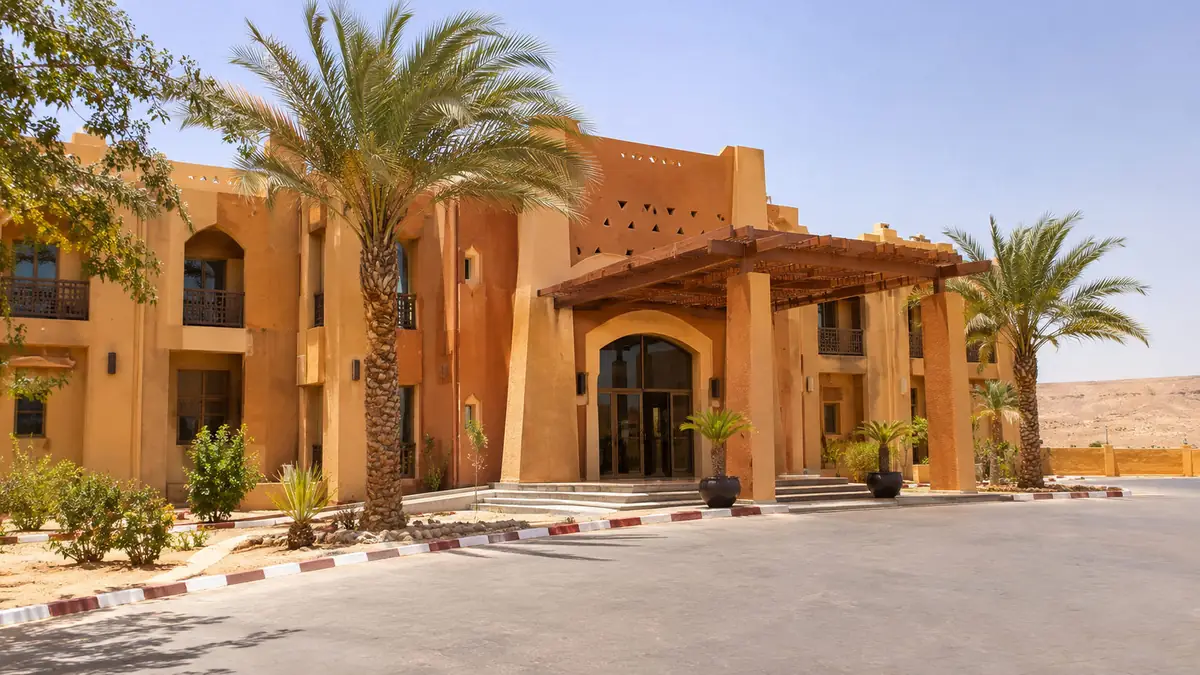
Naama, a provincial capital standing at roughly 1,200 metres on the high plateaus of western Algeria, has few hotels, yet booking rooms there is straightforward for anyone who calls ahead and asks for a direct confirmation. The quiet administrative town, calmer than its neighbour Mecheria, mostly receives officials on assignment, traders, visiting families and travellers heading for Ain Sefra and the Sahara. The choice is modest, stays follow the rhythm of the steppe, and every address deserves a check before the journey begins.
Hotel comparison for Algeria
Pick a city and a star rating, then run the search.
No hotel listed for this city yet.
Naama, a provincial capital on the high plateaus
Naama lies about 1,176 metres above sea level, in open steppe country west of a large salt flat and the Djebel Malah. It became the seat of its province during the administrative reorganisation of the nineteen-eighties, having previously belonged to the Saida region, and the choice stirred some rivalry with Mecheria and Ain Sefra. The municipality has a little over 16,000 inhabitants, third in the province behind Mecheria and Ain Sefra.
Daily life revolves around public services: government offices, a hospital, a university centre and neighbourhood shops. The province touches the Moroccan border and is flanked by Tlemcen and Sidi Bel Abbes to the north, El Bayadh to the east and Bechar to the south. That gateway position explains why very different visitors turn up, from the civil servant with a file to settle to the lorry driver breaking a long run between the north-west and the deep south.
For a traveller used to the large cities of the north, the contrast is clear: little traffic after dark, streets that empty early, and a centre where the essentials, from the pharmacy to the filling station, can nevertheless be found.
Naama's hotels: a small supply worth understanding first
Naama is not a hotel destination in the usual sense. The major booking platforms list very few properties across the whole province, and no international chain operates in town. Accommodation rests on a handful of modest hotels, public or private guesthouses near the centre, and furnished flats or rooms in family homes that are found largely by word of mouth.
In that setting, assume nothing. Before travelling, ask by phone whether the property is open, whether heating works in winter, whether hot water runs all day and whether parking is available. Facilities differ widely from one address to the next, and a star rating copied onto a directory does not always reflect the real state of the rooms. If you expect to arrive late, a short call giving your estimated time spares you a closed door.
One practical detail is that the exact address of a property is sometimes given by landmark, such as near a certain administrative office or junction, so ask for a description of the route rather than relying on the street name alone.
Booking rooms in Naama: how it works for short stays
Because supply is thin, reserving a room is often done over the phone rather than on a retail website. Write down who answered, the date, the room type and the length of stay, then ask for a written message repeating those details. A chat exchange is enough, as long as it stays dated and legible.
Busy spells coincide with official missions, university exam periods and family trips during religious holidays. At those moments, start several days ahead. Payment is frequently made on arrival, in dinars and cash, since card terminals are not universal in a town this size, so bring the sum you need. Foreign guests show a passport at reception, and Algerian guests an identity card.
Bear in mind too that total capacity stays small. A group of around ten people will often have to split between several addresses or turn to Mecheria, which is larger, to find enough rooms for everyone.
Getting to Naama: National Road 6, rail and Mecheria airport
National Road 6, which links the north-west to the south of the country, runs through the town. Mecheria is about 38 kilometres away, Ain Sefra 65 to 70 kilometres to the south, Tlemcen 240 kilometres, Oran 352 kilometres and Bechar 320 kilometres. Most visitors arrive by car, shared taxi or coach from those cities.
Naama has a station on the Oran to Bechar railway, so the town can be reached by train from western Algeria. The nearest airport is at Mecheria, code MZW. Commercial flights there change from one period to another, which is why the national carriers should be consulted before an itinerary is built. If in doubt, Tlemcen or Oran airport remains a fallback, followed by a drive of several hours.
If you drive at night, stay cautious: the road crosses steppe where flocks can wander onto the carriageway, and the gaps between filling stations are sometimes long. Fill the tank in Naama before setting off again.
Naama's climate: hard winters, scorching summers and cool nights
The climate is cold desert, with little rain: about 219 millimetres a year, falling on roughly forty days. The contrast between seasons is sharp. Winter nights regularly drop below freezing, with a record close to minus 13 degrees, while summers are very hot, with readings of around 41 degrees recorded.
That shapes the choice of room. In winter, dependable heating and thick blankets matter more than a view or an elaborate breakfast. In summer, air-conditioning or a good fan comes first, and a room facing away from the afternoon sun helps with sleep. Spring and autumn are the best times for being outdoors, when days stay dry and temperature swings are bearable.
Sand-laden wind and short spring storms can slow traffic. Check the forecast the day before, keep some slack in your schedule and avoid planning a very tight connection with a train or a flight.
Around Naama: ksour, rock engravings and palm groves
The province holds a rare heritage for people who love Saharan landscapes. It counts more than two thousand rock-engraving figures, the ksour of Assela, Moghrar, Sfissifa and Tiout, the palm groves of Moghrar, Tiout and Assela, and the hot spring of Ain Ouarka. At Rouis El Djir, dinosaur traces make up a kind of open-air museum.
Most of these sites are visited from Ain Sefra or Mecheria, yet Naama works as a calm base for a first night or a detour. Distances are long and side roads see little traffic, so set off in the morning, carry water and tell your host when you expect to be back. A local guide who knows the tracks saves you from getting lost and helps you find engravings without damaging them.
Visited places deserve respect: do not touch engraved surfaces, leave no litter, and ask permission before photographing residents or their gardens. Local guides know where access is regulated.
Naama hotels and rooms: choosing according to the reason for travel
The right choice depends on why you are going. For a work or administrative trip, closeness to the town centre and the offices comes first: a simple, clean room with a decent connection is enough. For a one-night stop on the road south, easy access from the national road and safe parking count for more.
Families lean towards rooms with several beds or a furnished flat, cheaper over several days. Walkers appreciate a host who can advise on tracks and sites. In every case, compare what Naama offers with Mecheria and Ain Sefra: if the town suits you for sleeping, the neighbouring stop sometimes has a wider choice. Keep a fallback in mind, since a full address in high season leaves few alternatives locally.
On a long journey, keep your list of bookings on paper as well as on your phone, with each property's number, so you can warn them of a delay or an unplanned change of route.
Frequently asked questions
Are there many hotels in Naama?
No, supply is limited: a few modest properties and rooms in family homes. Mecheria and Ain Sefra, being larger, sometimes offer a wider choice. Phone ahead to confirm that a property is open and to check its facilities before you travel.
How do I reach Naama from Oran or Tlemcen?
Use National Road 6: roughly 352 kilometres from Oran and 240 from Tlemcen. The town's station is also on the Oran to Bechar railway line, and Mecheria airport lies nearby, though flights there vary between periods.
When is the best time to stay in Naama?
Spring and autumn suit best, with dry days and bearable temperatures. Winter is cold, with frost at night, and summer is very hot, so pick a room that is heated or air-conditioned according to the season.
Further reading
- Naama, town overview : Encyclopaedia entry covering the location, elevation, population and climate of Naama.
- Naama Province, geography and districts : For Naama: Overview of the province, its size, districts and main towns including Mecheria.