
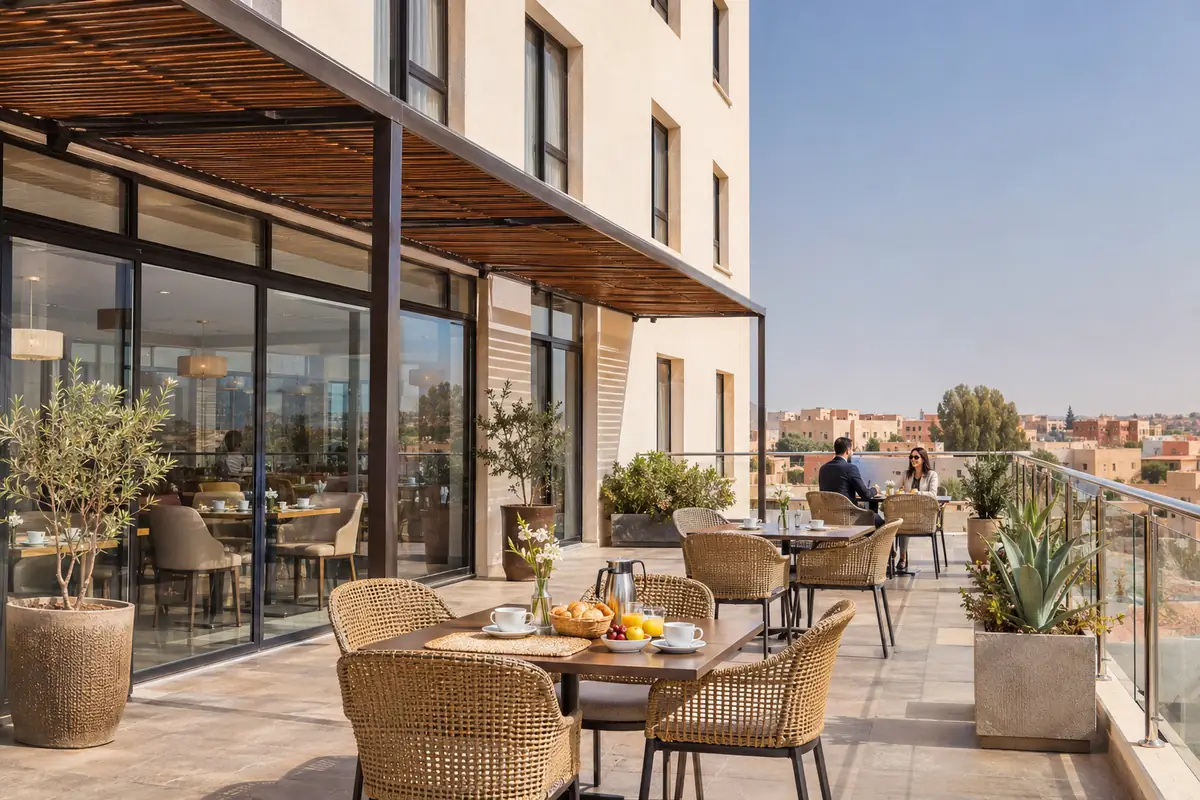
M'Sila is the capital of its wilaya and the main town of the Hodna plain, where visitors look for hotels, simple booking, comfortable rooms, reliable accommodation and short stays between Algiers, Setif and Bou Saada. The city sits beside the Ksob wadi at about 450 metres above sea level and receives mainly business travellers, families visiting relatives and people connected with the university. Choice is modest, with a handful of city hotels, and travellers wanting a wider range often combine M'Sila with nearby Bou Saada or the Beni Hammad fortress.
Hotel comparison for Algeria
Pick a city and a star rating, then run the search.
| Hotel | City | Stars | Area | Observed price (US$) |
|---|---|---|---|---|
| Hotel El K'sob | M'Sila | — | M'Sila | — |
| Hôtel Bosphorus | M'Sila | — | M'Sila | — |
| Hôtel Kalaa | M'Sila | — | Route de Bordj Bou Arreridj | — |
3 hotel(s) found
M'Sila at a glance: a steppe city on the Hodna plain
M'Sila is the administrative centre of the wilaya of the same name, on the northern edge of Algeria's High Plateaus. The city lies on the banks of the Ksob wadi, at roughly 450 metres of altitude, and has well over 130,000 inhabitants according to the latest census. Its Berber name is Tamsilt, and tradition says it was founded by the Sanhaja in the tenth century.
Today it is a working provincial city: wide avenues, markets, shops, cafes, hospitals, government offices and a university. The surrounding steppe supports a large sheep-farming economy, and local industry includes cement and power generation.
Do not expect a resort. M'Sila suits people who have business or family reasons to be here, and travellers who want a base for exploring historic sites, oases and the salt lake of the Chott El Hodna. The pace is calm, services are basic but sufficient, and prices for food and transport are generally modest.
Getting to M'Sila by road, air and public transport
M'Sila lies about 248 kilometres south-east of Algiers, and most visitors arrive by road. National roads link the city with Bordj Bou Arreridj, Setif, Bou Saada and the capital, and intercity buses and taxis serve the town. A taxi covers the last stretch to your hotel.
There is no passenger airport in the city. The nearest one is at Setif, about 125 kilometres away, so plan on a car or taxi transfer after landing. Railway links, for example towards Boughezoul and Bordj Bou Arreridj, have been discussed and are described as projects, so do not count on a train for now.
- From Algiers: about 248 km to the south-east.
- From Setif airport: about 125 km.
- From Bou Saada: about 70 km to the north-east.
If you drive, check that your hotel has parking. Hotel Kalaa, for instance, lists free parking for guests. Fuel and road conditions are easy on the main routes, but allow extra time in winter and in the heat of summer.
M'Sila hotels and booking: rooms, facilities and what to ask
Hotel capacity in M'Sila is limited. Hotel Kalaa, on the road to Bordj Bou Arreridj and within walking distance of the centre, is the property most often listed; travel sites mention a restaurant, a garden, an outdoor pool, a lift, parking and wi-fi. Other names that appear in travel directories include Hotel Bosphorus and Hotel El K'sob.
Because the choice is small, booking ahead matters, especially around university exam periods, official visits and family celebrations, when rooms disappear quickly. A short phone call or message is often more reliable than an online confirmation, as smaller hotels do not always update their availability.
When you ask for rooms, state your arrival date, the number of guests, the bed type you need and whether you need parking or an early breakfast. Standards differ from one hotel to another, so ask about heating, air conditioning, hot water and the lift before you travel rather than after you arrive.
Where to stay: districts and neighbouring towns
The city is compact. The centre holds the shops, cafes and offices, so staying there lets you manage most errands on foot or with a short taxi ride. The Kalaa hotel sits on the Bordj Bou Arreridj road, a more open position that is easier for drivers.
Families of students, visiting lecturers and examiners often prefer the university side of town. The University of M'Sila has several faculties and tens of thousands of students, which creates busy periods for beds during the academic year.
If your main aim is sightseeing, consider other bases. Bou Saada, about 70 kilometres away, has, for example, the Kerdada hotel, known for its Moorish-style architecture. Near the Beni Hammad fortress, in the Maadid area, a small hostel is listed. In every case, ask for the exact distance and the access road before you book, because mountain roads are slower than the map suggests.
Accommodation and stays beyond the city hotels
Accommodation around M'Sila works on three levels. First come the city hotels, useful for one or two nights. Second are the properties of nearby towns, above all Bordj Bou Arreridj and Bou Saada, which have their own hotels and suit a touring plan. Third are small guesthouses and hostels close to heritage sites, which are rarer and harder to contact.
For a stay of several days, many travellers sleep in Bou Saada, which is more tourist-oriented, and visit M'Sila as a day trip, or do the reverse when meetings are in town. Relatives visiting family often take a hotel for only a few nights.
Spring and religious holidays bring more visitors, and the hotel stock is small, so reserve early for these dates. If your plans are flexible, a mid-week arrival is usually easier than a weekend one, and a shorter stay is easier to place than a long block of rooms.
Things to see near M'Sila: fortress, oasis and springs
The headline sight is Al Qal'a of Beni Hammad, about 36 kilometres north-east of M'Sila on the flank of Djebel Maadid. A UNESCO World Heritage property, it preserves the ruins of the first capital of the Hammadid emirs, with about 7 kilometres of fortified walls, a great mosque with its minaret and a series of palaces.
Bou Saada, often called the gateway to the desert, is about 70 kilometres away. Its old medina, date groves, craft markets and nearby forests draw families, particularly in winter and during the summer heat. The zawiya of El Hamel, Roman remains, rock engravings and thermal springs such as Hammam Dhalaa are also named in the region.
The Chott El Hodna, a very large salt lake, completes the landscape for bird watchers and anyone who enjoys wide open space. In the wider area, finds from the Roman period include a mosaic showing a boar hunt, discovered at Dehahna.
Climate and the best time of year to visit
The climate is semi-arid: hot, dry summers and cool winters, with cold nights. Rainfall is low, around 250 millimetres a year, mostly in autumn and spring. The altitude explains the large difference between daytime and night-time temperatures.
Spring and autumn are the most comfortable seasons. Days are pleasant, excursions to the fortress and to Bou Saada are easy, and the light is excellent. Summer can be very hot around midday, so start early, carry water and choose an air-conditioned room. Winter is workable, with possible frost at night and some rain, so check that the heating works before you confirm a reservation.
- Spring and autumn: the easiest seasons for travel.
- Summer: water, a hat and air conditioning matter.
- Winter: pack warm clothes for the evening.
Practical advice: payment, documents and local habits
For a reservation, direct contact is the most dependable method in a town of this size. Confirm the dates, the room type and your arrival time, and ask for a clear confirmation that you can keep on your phone.
For payment, carry Algerian dinars in cash. Not every hotel has a card terminal, and settlement often happens at the front desk. At the time of booking, ask which payment methods are accepted and what the cancellation terms are.
- Bring an identity document; it is requested at check-in.
- Foreign visitors present their passport.
- Ask about breakfast times and late meals.
The town is quiet, and ordinary precautions are enough: do not leave valuables visible in a parked car and keep your papers with you. Outside the main roads, ask about road conditions before heading into the Hodna steppe or toward the desert, and tell the hotel where you are going if you plan a long day trip.
Frequently asked questions
Where can I stay in M'Sila?
M'Sila has few hotels. Hotel Kalaa on the road to Bordj Bou Arreridj is the most listed, along with names such as Bosphorus and El K'sob. Bou Saada, about 70 kilometres away, offers a wider choice.
How do I get from Algiers to M'Sila?
M'Sila is about 248 kilometres south-east of Algiers and is reached mainly by road, by car, bus or shared taxi. The nearest airport is Setif, roughly 125 kilometres away.
Can I visit the Beni Hammad fortress from M'Sila?
Yes. This UNESCO-listed ruin lies about 36 kilometres north-east of M'Sila on the flank of Djebel Maadid. Plan a day trip by car or with a driver, and wear sturdy shoes.
Further reading
- UNESCO World Heritage Centre: Al Qal'a of Beni Hammad : Official World Heritage entry for the Beni Hammad fortress, about 36 km north-east of M'Sila.