
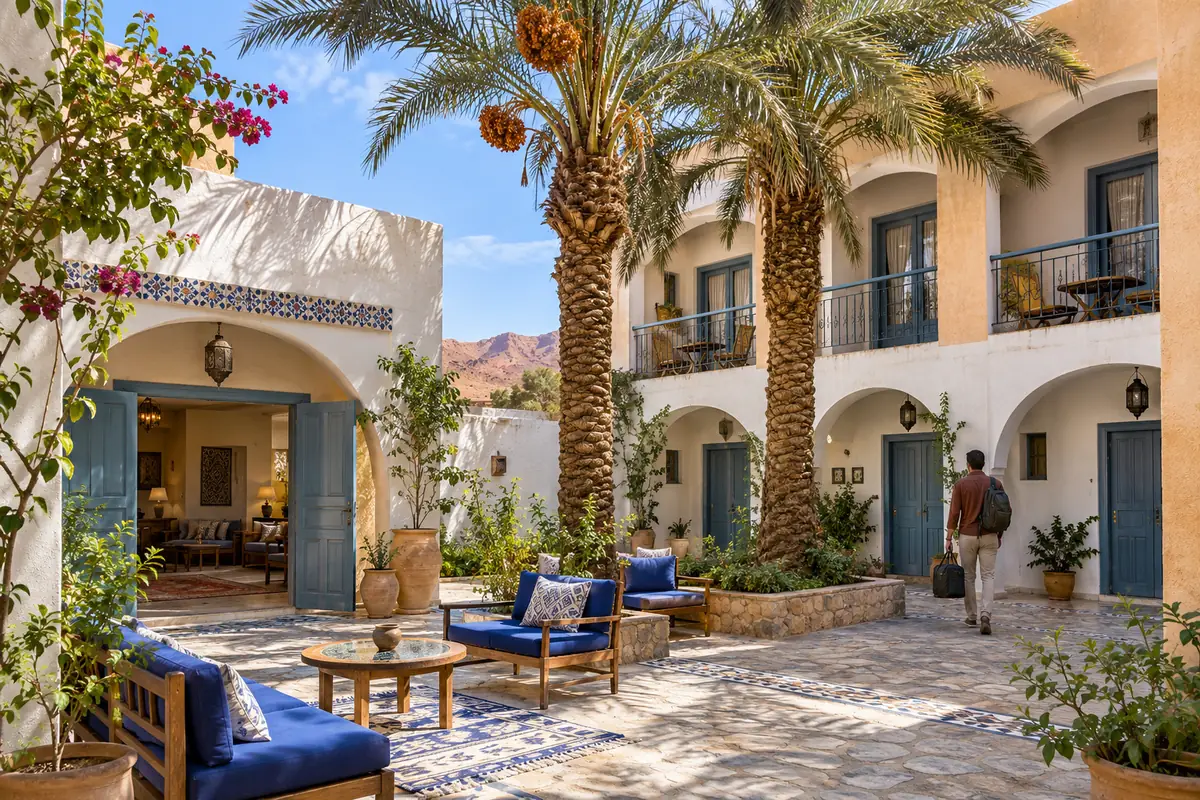
Bou Saada, in M'Sila province, is a Saharan oasis nicknamed the city of happiness, about 240 kilometres south-east of Algiers. Its hotels are few, and booking rooms mostly concerns short stays: sightseeing, a stopover between the north and the south, or a work trip. Visitors come for the palm grove, the riverbed, the old ksar, the house-museum of the painter Étienne Dinet and the silver crafts, in an oasis that marks the gateway to the desert, with hot summers, cool winters and a pleasant autumn season.
Hotel comparison for Algeria
Pick a city and a star rating, then run the search.
| Hotel | City | Stars | Area | Observed price (US$) |
|---|---|---|---|---|
| Hôtel Le Caid | Bou Saada | ★★★★ | Bou Saâda – Bou Saâda | ≈ 89 |
| Hôtel Kerdada | Bou Saada | ★★★ | Bou Saâda – Bou Saâda | ≈ 89 |
| Hôtel Kerdada | Bou Saada | — | Centre de Bou Saâda, près de la place des Martyrs | — |
| Hôtel Le Caïd | Bou Saada | — | Rue Nacereddine Dinet, près du musée Dinet | — |
| Oasis Hotel | Bou Saada | — | Bou Saâda – Bou Saâda | — |
5 hotel(s) found
Bou Saada, an oasis at the edge of the Sahara
Bou Saada belongs to M'Sila province and has more than 110,000 inhabitants, which makes it the second town of the province after the provincial capital. It is presented as the Saharan oasis closest to the Algerian coast: mountains lie to the north, and steppe country that announces the desert stretches to the south.
Its nickname, the city of happiness, comes from the welcome of its people and from the softness of the palm grove along the riverbed. Visitors find a lively shopping centre, an old ksar with vaulted lanes, a craftsmen's market and newer districts built later.
The orientalist painter Étienne Dinet settled here and painted many pictures; his house is now a museum and one of the landmarks of the town.
Reaching the town: roads and distances
The town is reached mainly by road. From Algiers, national road 8 arrives in Bou Saada after roughly 240 kilometres, depending on whether you take the route through the Lakhdaria gorges or through the Tablat mountains. National road 45 links the town to M'Sila, about 70 kilometres away, and national road 46 leads toward Djelfa, about 120 kilometres away.
Bordj Bou Arréridj lies around 130 kilometres off and Biskra around 175 kilometres, which makes Bou Saada a natural stop for anyone crossing the High Plateaus toward the south. Travellers from abroad usually pass through Algiers first and continue by road, by car, taxi or coach.
Allow plenty of time for the journey: traffic on mountain roads can slow progress, especially on days when holidays begin.
Hotels in Bou Saada: a limited supply
The town has few hotels, and booking platforms list only a handful. The two addresses mentioned most often are Hôtel Le Caïd, on Rue Nacereddine Dinet, about ten minutes on foot from the Dinet museum and under a kilometre from Martyrs' Square, and Hôtel Kerdada, around fifteen minutes on foot from the same square and from the museum.
According to online booking listings, Le Caïd offers air-conditioned rooms with private bathrooms, free on-site parking and a continental breakfast, with staff who speak Arabic, French and English. Check this information before you arrive, because it can change.
Because supply is restricted, do not count on finding a free room at the last minute during holiday periods and large gatherings.
Neighbourhoods and landmarks for choosing a room
The town centre around Martyrs' Square gathers shops, cafés, small restaurants and taxi stops; it is the most practical area for anyone without a car. The Dinet museum, the En-Nakhla mosque and the lanes of the old ksar can all be visited on foot from there, which spares you the search for parking in narrow streets.
Along the riverbed and the palm grove, the landscape is quieter and greener, with pleasant walks at the end of the day. Streets close to the national roads suit travellers who only stop for the night, because they avoid crossing the centre when traffic is heavy.
Whichever area you pick, ask the hotel whether access by car is easy, where to leave the vehicle overnight and whether the rooms face the street, which is noisier, or the back, which is calmer.
Staying in winter, spring or summer
The climate is a cold desert type, with hot summers, cool winters and scarce rain, which falls mainly in winter, about 200 millimetres a year. Nights can be cool from autumn onward, and snow sometimes falls on the neighbouring mountains.
Autumn and winter are the two most favourable seasons: days are mild, the light on the palm grove is beautiful and walking is pleasant. In spring temperatures climb gradually, whereas in midsummer the heat makes outings difficult around midday.
In any season, pack a jacket for the evening, water, a hat and closed shoes for walking along the riverbed and on stony paths. Because the air is dry, drink regularly even when it does not feel hot, and plan the longest walks for the morning or the late afternoon, when the temperatures are easier to bear.
Sights and crafts worth seeing
The house-museum of Nasreddine Dinet is the first place to see: it recalls the painter's life, his stay in the town and his tomb. The old ksar, Fort Cavaignac, the Ferrero mill and the En-Nakhla mosque, or Palm mosque, complete a walking route of half a day.
The craftsmen's market offers silver jewellery, woven carpets and the Bou Saada knife, a local product known throughout the country. In the surroundings, the zawiya of El Hamel is a well-known religious and teaching centre, and the rock engravings of Ben Srour interest prehistory enthusiasts.
- Bargain politely in craft shops.
- Ask permission before photographing local people.
- Wear modest clothes when visiting religious places.
Preparing a stay in the region
The most useful stops around Bou Saada are M'Sila, about 70 kilometres away, which is the provincial capital and the most populous town, as well as Djelfa and Biskra, farther off. For overnight stays nearby, ask the establishments directly, because the supply in those towns can vary.
If you drive down from the north, leave early in the morning: the road is long, and night falls earlier in winter. Keep some fuel in reserve, a charged phone and the hotel's address to hand.
Everyday safety raises no particular difficulty; the usual precautions of a mid-sized town are enough, with some care on the roads in the evening. Carry a copy of your identity document and keep valuables out of sight in the car, as you would anywhere else. If you plan a day trip to the surroundings, tell the hotel where you are going and when you expect to be back.
Reservations, payment and arrival
In a town where supply is limited, reservations are often made by phone or messaging in addition to online platforms. Confirm the room type, the number of nights and the arrival time, and ask for written confirmation if possible.
Paying in cash at reception is still common. Ask before leaving whether bank cards are accepted, because terminals are not available everywhere. An identity document or passport is required at check-in for every adult.
On arrival, check air conditioning or heating according to the season, hot water and breakfast hours. If you are running late, warn the property so that the room is kept for you. When you leave, ask for a receipt for the stay, and settle any extra charges, such as meals or parking, before you pack the car, so that nothing remains to be discussed on the morning of departure.
Frequently asked questions
Are there many hotels in Bou Saada?
No, supply is limited. Online platforms mainly list Hôtel Le Caïd and Hôtel Kerdada, both close to the centre and the Dinet museum. It is therefore wise to book in advance.
What is the best season to visit Bou Saada?
Autumn and winter are the most pleasant, with mild days and beautiful light on the palm grove. Summer is very hot around midday, and winter nights can be cool.
How do I get to Bou Saada from Algiers?
Most people go by road, along national road 8, for roughly 240 kilometres depending on the route. The town is about 70 kilometres from M'Sila and about 120 kilometres from Djelfa.
Further reading
- Bou Saada: town overview : Overview of the town's location, climate, crafts and old medina.