
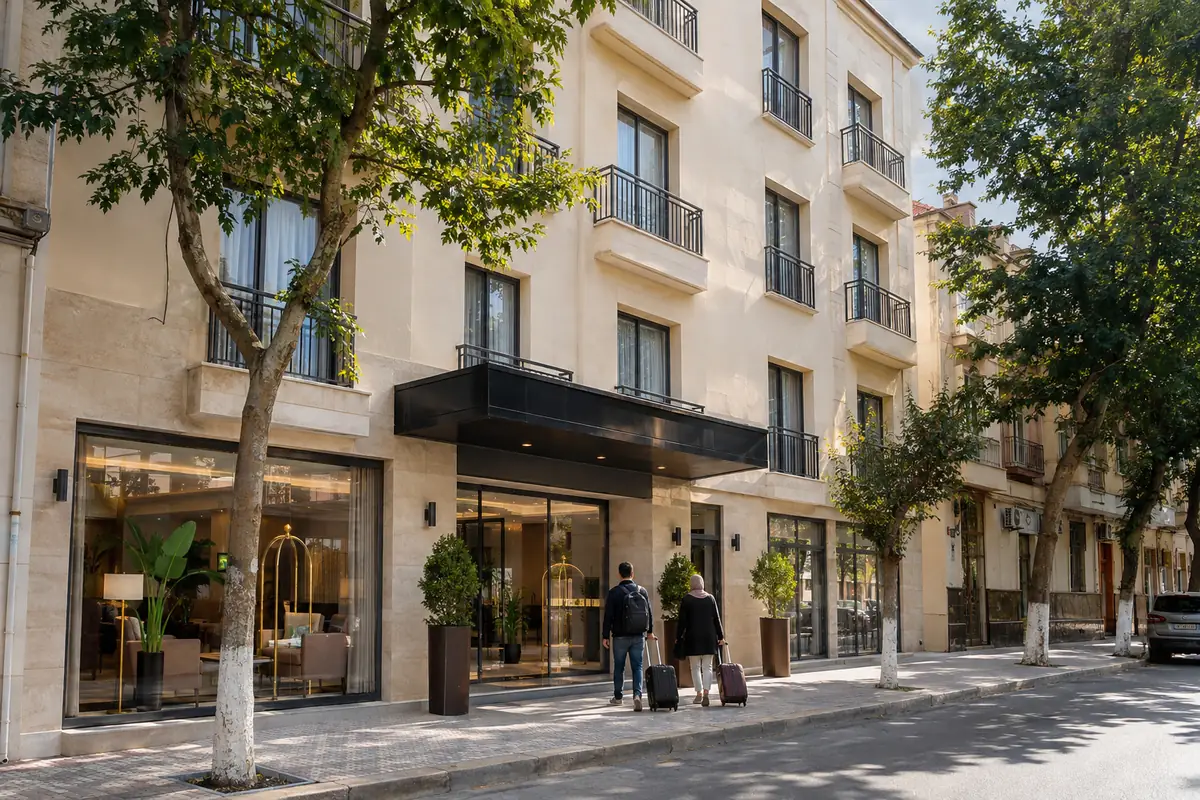
Sidi Bel Abbes is the capital of its own wilaya in western Algeria, a plain-country city on the Mekerra river about 470 metres above sea level, whose hotels and booking rooms serve mostly business trips, university stays and family visits. Founded by Foreign Legion soldiers and now an industrial and student town, it offers a handful of four-star addresses, several plain budget hotels near the centre and very few guesthouses. Most guests arrive through Oran or Tlemcen, both within roughly an hour and a half of the city by road.
Hotel comparison for Algeria
Pick a city and a star rating, then run the search.
| Hotel | City | Stars | Area | Observed price (US$) |
|---|---|---|---|---|
| Beni Tala | Sidi Bel Abbes | ★★★★ | Sidi Bel Abbès – Sidi Bel Abbès | — |
| Eden Bel Abbès | Sidi Bel Abbes | ★★★★ | Sidi Bel Abbès – Sidi Bel Abbès | ≈ 64 |
| Metropole | Sidi Bel Abbes | ★★ | Sidi Bel Abbès – Sidi Bel Abbès | — |
| Metropole II | Sidi Bel Abbes | ★★ | Sidi Bel Abbès – Sidi Bel Abbès | — |
| El Djazair | Sidi Bel Abbes | ★ | Sidi Bel Abbès – Sidi Bel Abbès | — |
| Mekerra | Sidi Bel Abbes | ★ | Sidi Bel Abbès – Sidi Bel Abbès | — |
| Palace | Sidi Bel Abbes | ★ | Sidi Bel Abbès – Sidi Bel Abbès | — |
7 hotel(s) found
Sidi Bel Abbes between Oran and Tlemcen: a major western city
Sidi Bel Abbes is the administrative centre of the wilaya that carries its name, in north-western Algeria. The city stands on the banks of the Mekerra, once called the Sig, in the middle of a wide farming plain at an altitude of roughly 470 metres. More than 200,000 people live here, which makes it one of the larger urban centres of the Oran region.
Road distances are short: about 82 km to Oran, 87 km to Tlemcen, 60 km to Ain Temouchent, 93 km to Mascara and 96 km to Saida. That crossroads position explains why many travellers spend a night here instead of in a regional capital.
The street plan keeps the regular grid of a town laid out in the middle of the nineteenth century: straight avenues, shaded squares and busy shopping boulevards. For a stay, the centre remains the most practical area, because shops, cafes, restaurants, banks and bus stations are all gathered there.
Hotels in Sidi Bel Abbes: what kinds of accommodation exist
The city offers a classic range of urban lodging. Upper-category hotels are few: the Eden Bel Abbes and the Beni Tala are listed as four-star properties, and the first is described with a pool, restaurants, a shuttle, parking and conference rooms.
Next come mid-range and budget hotels, notably the Metropole and Metropole II at two stars, then the Palace, the Mekerra and the El Djazair at one star, according to the tourism directorate's listing. Comfort varies a great deal from one address to another, so look at recent photos and recent guest comments before deciding.
No large international chain operates in the city, and guesthouses are rare. Travellers who need more choice, for instance for a group, also look at Oran or Tlemcen, both under two hours away by road.
Getting there: road, train, tram and nearby airports
Sidi Bel Abbes has no scheduled air service that is useful to visitors. Most people fly into Oran Es Senia or Tlemcen Zenata and continue by road. Intercity taxis, cars with a driver and buses then cover the distance in under two hours or so, depending on traffic. Travellers arriving from Algiers usually change in Oran or take the train and a taxi at the end.
The city station is one of the busiest in the country, with trains to Oran, Tlemcen, Saida and Bechar. Timetables change with the season, so check them with the national railway company before travelling.
Inside the city, a modern tram line complements taxis and buses. A short taxi ride is the simplest way to reach a hotel with luggage; agree the fare or insist on the meter before getting in. At the station, hotel staff can often call a trusted driver for you if you tell them your arrival time.
Choosing where to sleep according to your reason for travel
Business visitors come for local industry: farm machinery, electrical equipment, footwear and dairy products. They look for a central hotel, reliable internet and a restaurant on site. Four-star hotels meet these expectations best, and meeting rooms are a real advantage.
People linked to Djillali Liabes University, whether students, parents, lecturers or conference speakers, often settle for a simpler place close to the centre and to transport lines. Book early around thesis defences, entrance competitions and the start of the academic year, because the few good rooms fill quickly then.
Families visiting relatives usually prefer a quiet hotel with parking. Passing tourists use the city as a stopover between the Oran coast and the high plateaus, staying one or two nights, and for them a safe car park and an early breakfast matter more than leisure facilities.
Hotels and booking rooms: how reservations work locally
Reservations are made by phone, by direct message or through online platforms that list the city's hotels. For smaller places the online presence can be thin, and a phone call is then the most reliable way to confirm that a room is waiting for you.
On arrival, an identity card or passport is requested for every adult. Unmarried couples should expect house rules that differ from one hotel to the next, so ask before booking. Check-in usually starts in the early afternoon and check-out is before noon, but this varies.
Cash in Algerian dinars is still very common. International bank cards are not accepted everywhere, so ask in advance which payment method is taken and bring enough cash. Keep written confirmation of the booking and the name of the person who took it.
Districts and areas that suit a short stay
The city centre is the default choice: you can walk between the public garden, which dates from the middle of the nineteenth century, the squares, the cafes and the shops. Evenings are livelier here, especially in summer, when social life moves to after sunset.
Streets around the main avenues and the station suit travellers who take an early train. Residential districts are calmer but less well served by taxis at night, so check how you will get back before going out for dinner.
For nearby outings, count on a car or taxi: Lake Sidi Mohamed Benali and the Louza recreation forest lie outside the heart of town, and the Tessala hills, where the ruins of a Roman fort remain, need a short excursion. Ask the hotel desk about road conditions and opening hours, and note that public gardens and parks are busiest on Friday afternoons and at weekends, when local families go out together.
Climate, seasons and the best time to visit
The climate is continental and semi-arid: summers are very hot, winters fairly cool, and snow is rare. July and August are hard for walking in the daytime, and air conditioning becomes a decisive point when choosing a room.
Spring and autumn are the most pleasant seasons, with mild temperatures and green fields across the plain. Winter can be damp and cold, so heating matters; make sure it works in the room you are offered. Evenings can be cool even in early summer because of the altitude, so a light jacket is useful all year.
During Ramadan the rhythm changes: restaurants open mainly after sunset and some shops close during the day. Religious holidays and the summer break also bring more families, which makes reserving in advance the sensible option. Outside those peaks, hotels are generally easier to book at short notice, although a phone call the day before is still wise.
History of the city, the Foreign Legion and heritage
The city was built in the middle of the nineteenth century on the right bank of the Mekerra by Legion soldiers, following the plans of an engineer captain, and it remained the garrison town and home base of the Foreign Legion until independence. Its name comes from a local saint, Sidi Bel Abbes El Bouzidi, whose domed tomb stands on the left bank.
This past explains the grid plan, the former military districts and colonial-style architecture in the centre. Visitors curious about military history come looking for traces of it, although the visible remains are limited. The grid of avenues, with its regular blocks and public squares, is itself the clearest reminder of how the town was planned from the start, and it still shapes how visitors find their way on foot.
Older still, the region keeps Roman ruins in the Tessala hills. Today the city looks towards education, trade and industry, and it is known as a university hub of western Algeria. Its weekly markets, its bakeries and its cafes give the centre a lively, local character that business visitors often appreciate after a long day of meetings.
Practical advice and everyday safety
This is an active provincial city where ordinary precautions are enough: keep papers and money on you, avoid showing valuables and prefer registered taxis after dark. Most hotels keep their reception open around the clock. Carry small notes in dinars for taxis, snacks and tips, because change is not always available.
Before leaving, check the cancellation terms, whether air conditioning or heating is provided, parking and breakfast. If you arrive late, tell the hotel your approximate time so the room is not given to someone else. Ask also whether breakfast is included and at what time it is served, particularly during Ramadan.
A phone with a local SIM card makes it easier to talk to drivers and reception staff. For trips towards the border or isolated areas, always ask the local authorities about the rules in force, and avoid driving at night on poorly lit secondary roads, especially in winter.
Frequently asked questions
Which hotels can you find in Sidi Bel Abbes?
The city has four-star hotels such as the Eden Bel Abbes and the Beni Tala, two-star ones such as the Metropole, and one-star ones such as the Palace, the Mekerra or the El Djazair, plus a few local places.
How do you get to Sidi Bel Abbes from Oran or Tlemcen?
Oran is about 82 km away and Tlemcen about 87 km. You can come by car, intercity taxi, bus or train, since the city has a major railway station with services to both.
When is the best season to stay in Sidi Bel Abbes?
Spring and autumn are the most pleasant, because summer is very hot and winter fairly cool. Check air conditioning for the summer and heating for the winter before you book a room.
Further reading
- Sidi Bel Abbes on Wikipedia : Encyclopedia entry covering the city, its railway, climate, university and Foreign Legion history.