
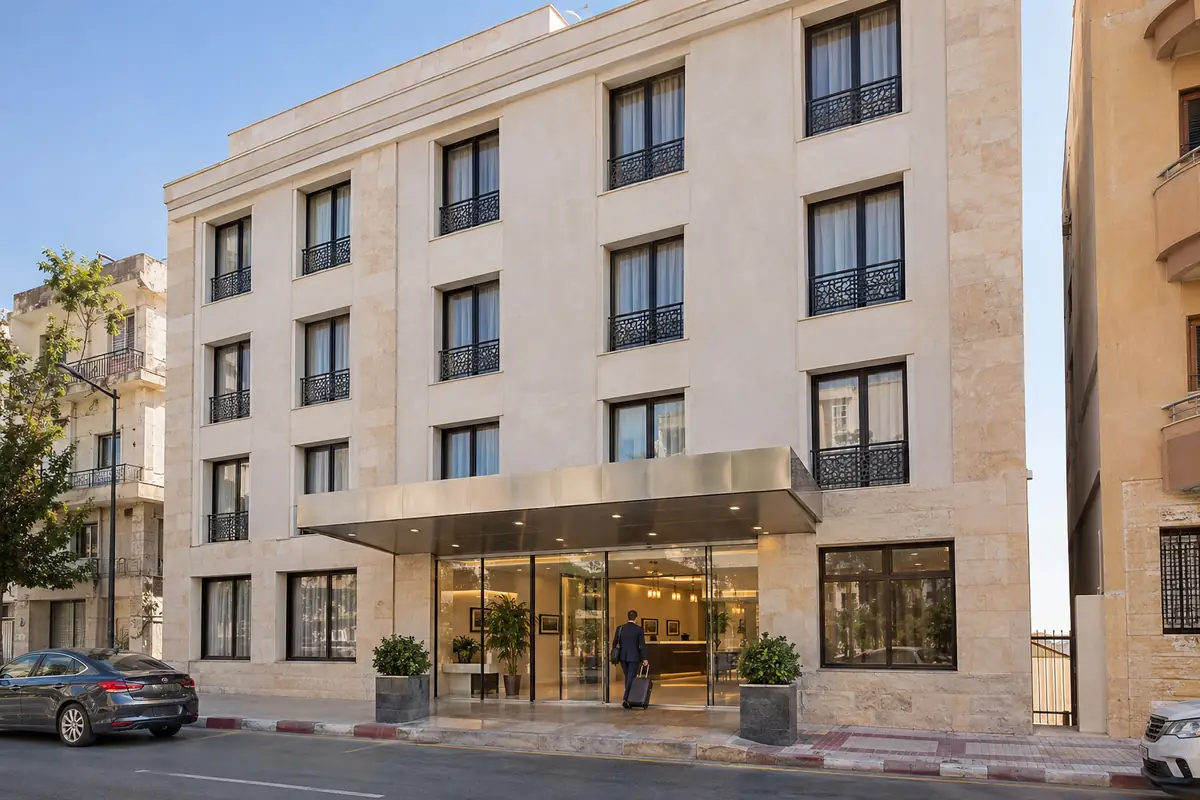
Ain Beida is the largest town in Oum El Bouaghi province, standing at roughly one thousand metres above sea level on the high plateaus of eastern Algeria. Its hotels, booking options, rooms and accommodation serve travellers moving between Constantine, Tebessa and Khenchela rather than beach holidaymakers. The choice is modest and aimed at traders, families and business visitors. Two national roads, the RN10 and the RN88, meet in the centre, which makes the town a natural stopover for anyone crossing the region by car, and a sensible base for short trips across the surrounding plateau.
Hotel comparison for Algeria
Pick a city and a star rating, then run the search.
No hotel listed for this city yet.
Where Ain Beida is and how to get there
The town is the main urban centre of Oum El Bouaghi province in the east of the country, set on a plateau between about 940 and 1,120 metres above sea level. Oum El Bouaghi lies some thirty kilometres to the north-west and Khenchela around fifty kilometres to the south-west, so Ain Beida sits in the middle of a triangle of mid-sized towns.
By road, the RN10 links Constantine with Tebessa and passes through the town, while the RN88 links Guelma with Khenchela; the two routes cross in the centre. Visitors from abroad usually land at Constantine airport and continue by taxi, minibus or shared long-distance car. Rail is not a dependable option for passengers, so it is wise to plan the journey by road and to leave enough daylight hours for the drive, especially in winter.
Hotels in Ain Beida: what you can realistically expect
Ain Beida is not a destination for large resort hotels. The town's hotels are small, often family run, and welcome business travellers, people passing through and visitors with relatives nearby. Expect simple, practical places, some officially classified and others without stars, offering functional rooms, breakfast and direct contact at the reception desk.
Guests who want more comfort, such as a pool, conference rooms or a wider choice of restaurants, usually stay in Constantine and drive over. Capacity is limited, and rooms fill quickly around religious holidays, the start of the school year and large family gatherings. Before travelling, confirm that the property is open, check its current condition and obtain a working phone number, instead of relying on an old listing that may no longer be accurate.
Booking rooms and accommodation: preparing your arrival
In a town of this size, booking rooms is still done largely by phone, sometimes by message on social networks, and less often through the big online platforms. Call the hotel a few days ahead and ask for a written or message confirmation of the room type, the number of nights and your expected arrival time.
If you travel with family, mention it: some places ask for identity documents for every adult at check-in. Ask whether heating works, which matters a great deal in winter on the plateaus, and whether parking is available. For a longer stay, a furnished flat or a relative's home is a common alternative, but it requires a local contact. Otherwise, spend a first night in a hotel and look for something longer-term once you know your way around, which carries far less risk than arranging everything blindly from abroad.
Neighbourhoods and areas to consider
The town centre, laid out on a grid during the colonial era, remains the most convenient area: shops, cafés, pharmacies, banks and bus stations are within walking distance. Staying close to the centre means you can walk in the daytime and need taxis only after dark.
The edges of the two national roads gather petrol stations, grill restaurants and a few places aimed at drivers and lorry crews. They suit a one-night stopover, but traffic noise can disturb sleep, so ask for a room away from the road. Newer residential districts on the outskirts are quiet but often far from the shops, and they assume you have a car or a taxi. Before choosing, look at a map and check the distance to the bus station and the hospital, two useful reference points for any stay of more than a night or two.
Accommodation in Ain Beida for business and family stays
Trade is the town's main activity. Merchants and wholesalers from across the east come to do business, which explains steady hotel use on weekdays and a quieter pattern at the weekend, which in Algeria falls on Friday and Saturday. Plateau agriculture, with cereals, market gardening and sheep, cattle and goats, also prompts seasonal visits.
Many family stays are visits to relatives, and the hotel then serves as a fallback or as a base during an event such as a wedding or a funeral. Students and trainees passing through usually look for modest rooms and short stays. In every case, stating clearly how long you plan to stay avoids misunderstandings about when the room must be vacated, and gives the staff a chance to tell you in advance if a block booking will arrive on one of your nights.
Climate and seasons on the high plateaus
At around a thousand metres, Ain Beida has a continental climate. Winters are cold, with frosty nights and occasional snow, while summers are hot and dry, with a wide gap between daytime and night-time temperatures. Spring and the beginning of autumn offer the most pleasant conditions for travel, with mild weather and clear roads.
In winter, heating is as important a criterion as being close to the centre: check that it is provided, and pack warm clothes even if you arrive from the coast. In summer, a fan or air conditioning is useful in the afternoon. Storms can briefly disrupt traffic. Check the forecast before driving from Constantine or Tebessa, particularly when snow is expected, and keep a full tank of fuel because stations can be spaced widely between the smaller towns of the plateau.
Heritage and things to see around the town
The name Ain Beida means the white spring. The site was already inhabited in antiquity as Marcimeni, a Roman stopover between Cirta, today's Constantine, and Theveste, today's Tebessa. The modern town has kept a grid-patterned centre typical of the colonial period, with a church, a synagogue, several mosques and older buildings, among them the Hôtel Orient, listed among the notable structures.
Around the town, the Aures region and local forests, which cover about a tenth of the municipality, make for short outings. Visitors interested in ancient remains can combine a stay with Tebessa, known for its Roman monuments and reachable along the RN10. These excursions work best with a local driver, because tourist signposting is discreet and distances on the plateaus always feel longer than they are, especially when the weather turns.
Payment, safety and practical advice
In small hotels, payment is frequently made in cash, in Algerian dinars, on arrival or departure. Bank cards are not accepted everywhere, so ask before you book and carry enough cash, remembering that cash machines are mostly in the town centre.
Always request a receipt showing the hotel's name, the length of stay and the agreed amount. The commercial streets are lively and safe in the daytime; at night, simply avoid poorly lit alleys and leave valuables in a safe or in the locked room. Keep the hotel's contact details on your phone, along with the number of a trusted taxi. Finally, always tell the hotel your arrival time if it will be late: in the late evening, reception staffing can be reduced or the front door closed, and a short phone call prevents a long wait on the pavement.
Frequently asked questions
Are there many hotels in Ain Beida?
The choice is limited and made up mainly of small establishments. Travellers who want a wide choice of rooms or upscale services usually go to Constantine first and then reach Ain Beida by national road.
How do I book a room in Ain Beida?
Booking is often done by phone or message directly with the hotel. Ask for confirmation of the room type, the number of nights and your arrival time, and check whether card payment is possible.
When is the best time to stay in Ain Beida?
Spring and early autumn are the most pleasant. In winter the cold and occasional snow mean you should check the heating, while hot summer days call for a ventilated or air-conditioned room.
Further reading
- Air Algérie : The national airline's English-language site: domestic flights, including to Constantine, the region's main air gateway.