
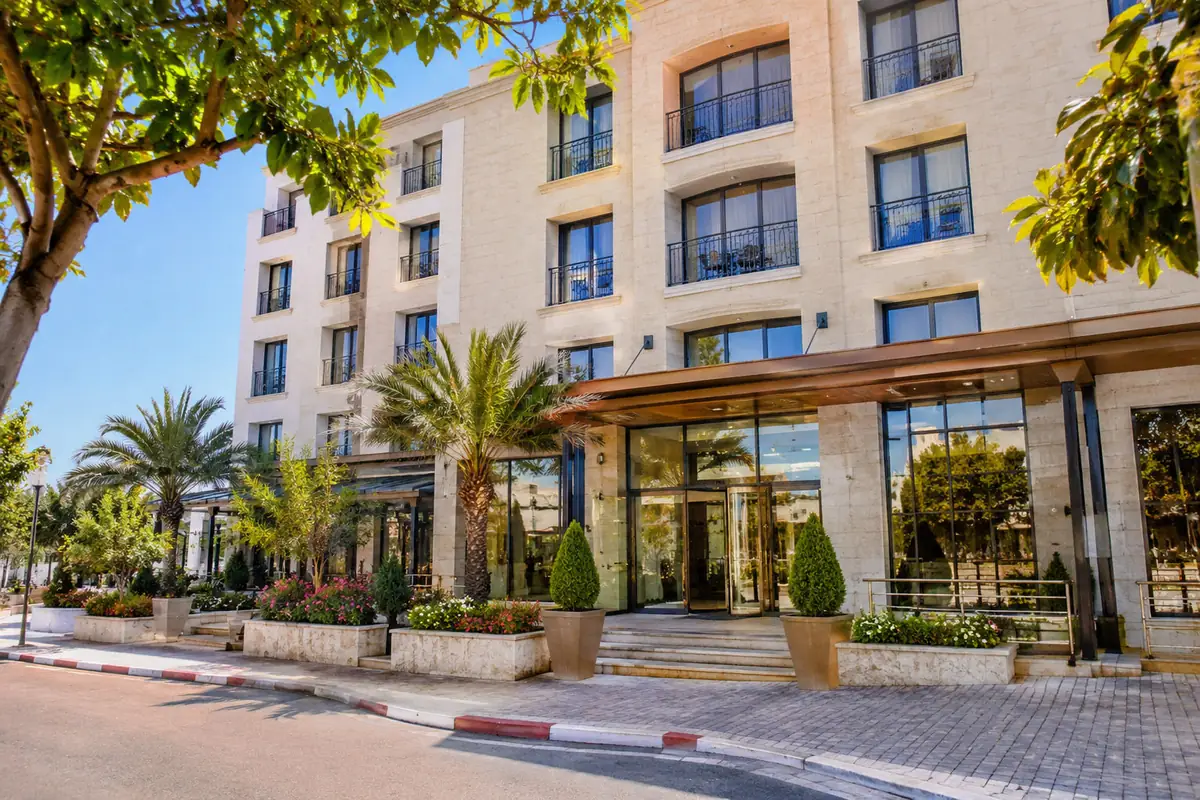
Lakhdaria, formerly Palestro, is a town in the north of Bouira Province, east of Algiers, set inside a bend of the Oued Isser and surrounded by hills. Its hotels are few, so booking rooms and arranging accommodation usually means weighing the town itself against Bouira and the capital. Visitors include families heading into Kabylie, business travellers tied to the local industrial sites and domestic holidaymakers drawn to the river gorges. A stay here is best planned in advance rather than improvised on arrival, because a spare room cannot be taken for granted.
Hotel comparison for Algeria
Pick a city and a star rating, then run the search.
No hotel listed for this city yet.
A river-valley town in the north of Bouira Province
Lakhdaria is the seat of a daira in the northern part of Bouira Province, on the edge of Kabylie. It lies in a loop of the Oued Isser and is ringed by mountains, the tallest of which, Lalla Moussaad, overlooks the town. Close by, the river has cut a gorge of roughly four kilometres, known today as the Ammal gorges and for a long time called the Palestro gorges.
The town sits east of Algiers and about forty kilometres north-west of Bouira, the provincial capital. That position on a through route shapes everyday life: the streets are busy with people who work in the capital, lorry drivers, families heading to mountain villages and farmers selling produce. Estimates put the population of the urban area at around fifty thousand, though figures differ by source and by the boundary used.
For a traveller this means a small, characterful town rather than a hotel destination. Lodging has to be thought about across the valley and the neighbouring towns, not within a large tourist centre.
Getting to Lakhdaria by rail, motorway and minibus
The town has a railway station on the line running east from Algiers, which is one of the easiest ways to arrive from the capital without a car. The East-West motorway passes close by, so drivers coming from Algiers, Boumerdès or Bouira reach the valley without long mountain detours.
A national coach station provides services to neighbouring provinces, including Boumerdès and Algiers, and shared minibuses connect the town with Bouira throughout the day. Inside Lakhdaria, small local minibuses and taxis cover short hops.
Visitors from abroad normally fly into Algiers international airport and continue by taxi, by a pre-arranged car or by train through the capital. Leave a generous margin in your schedule: roads and stations are crowded at rush hour and before weekends, and a tight connection out of Algiers can be undone by traffic.
Hotels in Lakhdaria: the accommodation actually available
None of the sources consulted names a classified hotel or a large establishment in Lakhdaria itself. The local offer therefore seems to consist of a few modest properties and informal arrangements that residents know better than international booking platforms. It is better to say so plainly than to promise a choice that does not exist.
This scarcity has a practical consequence: you do not pick a hotel in Lakhdaria the way you would in Algiers or Béjaïa. First confirm by phone that a room really exists and will be free on your dates, then ask what is included, for example breakfast, winter heating or somewhere to park.
Travellers who need a precise comfort level, a staffed reception around the clock or a detailed invoice for their employer usually book in a better-equipped neighbouring town and make the trip out and back in a day. That arrangement is common for small towns in the region and takes only a little forward planning.
Where to sleep nearby: Bouira, Boumerdès and Algiers
Bouira, the provincial capital, has a wider range of lodging and lies about forty kilometres away, a reasonable drive. It is the natural base for anyone exploring the Isser valley who wants restaurants, shops and administrative services close at hand.
On the coast, Boumerdès and its surroundings have seaside hotels that are handy in summer for combining a beach with an excursion inland. Algiers concentrates most of the country's hotel stock, from international chains to business hotels, and links to Lakhdaria by train or motorway.
The right pick depends on the purpose of the trip. A meeting at an industrial site suggests a business room in Algiers or Bouira, a family holiday suits a seaside base, and a simple stopover on the road east can be handled with one night in Bouira. Whatever you choose, write down the exact address and phone number before leaving your departure city.
Booking rooms in Lakhdaria: how to go about it
In a small town like this, booking rooms often means a direct call or message to the property rather than an online search engine. Ask for written confirmation, even a short one, stating your name, the dates, the room type and your expected arrival time, and keep it on your phone.
State the number of guests at the outset and, for a family stay, who is in the group. Payment is worth raising in advance too: many small Algerian properties take cash on the spot, and card terminals are not guaranteed. Bring enough dinars before you arrive, because cash machines in a small town can be out of service.
Carry your identity card or passport, which the property will ask to see at check-in. If you expect to arrive late, tell the manager: in Lakhdaria, where evenings are quiet, a reception desk may close after a certain hour, and it is wise not to end up facing a locked door.
The Ammal gorges, Koudiet Acerdoune dam and outdoor trips
The best-known attraction in the area is the Ammal gorge, the old Palestro pass, which the Oued Isser has carved through the mountain over about four kilometres. It draws mostly Algerian visitors, especially in summer, for the cool river and the cliff scenery.
The Koudiet Acerdoune dam on the Oued Isser supplies drinking water to several provinces and also marks the landscape of the valley. It is first a technical installation rather than a leisure spot, so ask locally about access and traffic rules around the works before you go.
Hikers will find tracks and paths in the nearby mountains, but equipment and caution matter: carry water, tell someone your route and avoid setting out alone on unfamiliar trails. For a day trip, a morning start leaves time to be back before dark, which falls quickly in a deep valley.
Local economy and business travel in the valley
Lakhdaria's economy rests on farming and a few industrial sites. The valley produces olives, citrus, fruit trees, field vegetables, grapes, poultry and honey. This agricultural wealth explains the busy markets and the number of traders in town.
The town also hosts a paint and varnish complex, a detergent complex and a national satellite telecommunications centre. These sites bring technicians, engineers and suppliers, some of whom stay several days in town or in neighbouring ones.
A work trip is best prepared with the company being visited: ask which properties it normally uses for guests and how access to the site is arranged, since it often requires authorisation. That avoids losing half a day looking for a room after a meeting and gives a more reliable picture of real lodging quality than any random review.
Lakhdaria's climate: a wetter valley than the rest of the province
Lakhdaria is one of the rainiest parts of Bouira Province, with average rainfall of about six hundred millimetres a year according to one source and somewhat more according to another. Rain falls mainly in winter, when mountain roads can turn slippery or be hit by mudslides.
Spring is the most pleasant time to discover the valley: slopes are green, temperatures mild and the gorges well supplied with water. Summer is hot in the enclosed valley and is when families come to enjoy the river, so rooms can get scarcer, including in nearby towns.
Autumn stays mild and suits visits, while winter calls for a waterproof coat and closed shoes. If you travel then, check road conditions before leaving and add margin to your journey time, because a storm can badly slow traffic on the routes that follow the Isser.
From Palestro to Lakhdaria: the history behind the name
Before the French conquest the area belonged to the Ait Oulmou, a Kabyle tribe with a marabout tradition. Emir Abdelkader set up camp in the region during his campaigns. The town was later founded as Palestro, after a battle of the Italian Risorgimento, and the name still lingers in local memory for the nearby gorges.
After independence the town took the name Lakhdaria in honour of Rabah Mokrani, known as Si Lakhdar, a fighter in the liberation war. Older residents still sometimes use the former name, and you will meet it on old documents, maps and signs: it is the same town.
The valley also lived through hard times during the dark decade, when many residents left. Daily life has since returned to normal and visitors travel freely. This local memory comes out in conversation with residents, who are usually welcoming to visitors interested in the history of the place.
Frequently asked questions
Are there hotels in Lakhdaria?
The local offer is very limited and none of the sources consulted names a classified hotel. Travellers often sleep in Bouira, Boumerdès or Algiers and visit Lakhdaria during the day by train or on the East-West motorway.
How do I get to Lakhdaria from Algiers?
The town has a station on the rail line running east from Algiers, and the East-West motorway passes nearby. Shared minibuses also connect Lakhdaria with Bouira throughout the day, which helps if you stay in the provincial capital.
What is there to see around Lakhdaria?
The best-known sight is the Ammal gorge, the former Palestro gorge, cut by the Oued Isser over roughly four kilometres. Algerian visitors come mostly in summer, and walkers use paths in the surrounding mountains.
Further reading
- Lakhdaria on Wikipedia : Overview of the town: location, history, economy and local population.